


The Jewish connection to Hebron has always been inarguable.
Hebron is one of Israel’s four holy cities, alongside Jerusalem, Tiberias and Safed. It is where Abraham purchased what would become the resting place of the Patriarchs and Matriarchs, a land agreement made nearly 4,000 years ago and recorded in the Torah, and the city where King David ruled for seven and a half years before moving the seat of his monarchy to Jerusalem. Judah the Maccabee liberated Hebron from the Edomites during the Second Temple Era, and King Herod built the structure surrounding the Caves of the Patriarchs that can still be found today.
Throughout the many years of the Jewish people’s exile from the Land of Israel, a steady Jewish presence in the city remained. In more recent history, the wellbeing of Hebron and her inhabitants was of primary concern to the Rebbes of Chabad-Lubavitch.
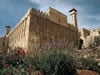
It’s a story the hundreds of thousands of visitors who converge on Hebron each year to pray at the Cave of the Patriarchs (Maarat Hamachpelah) could all learn more all about.
“People come, they pray at the Cave, and they leave,” explains Rabbi Danny Cohen, director of Chabad of Hebron. “But Hebron’s story is so much bigger, so much deeper. Now, we can finally show them.”
A new visitor center, opened last month by Chabad-Lubavitch of Hebron directly across from the Cave, is designed to do just that.
The “Gateway to Hebron” exhibition officially launched in May at the Field of Machpelah Visitor Center, offers an immersive multimedia experience tracing Hebron’s Jewish history from the time of Abraham to the present day, with particular focus on Chabad’s centuries-long connection to the city. The center is housed in the historic Gutnick Building, a stone’s throw from Mearat Hamachpelah.
.")
The City Behind the Cave
The $9 million exhibit uses film, visual recreations and immersive storytelling to bring history to life.
Chabad’s connection to Hebron dates to the earliest years of the movement. Rabbi Schneur Zalman of Liadi, the founder of Chabad-Lubavitch, sent financial support to strengthen the Jewish community there. His son, the Mitteler Rebbe, Rabbi DovBer of Lubavitch, went even further: he purchased property in the city and issued a call to Chassidim to come and build Jewish life in Hebron. He also sent his own daughter, Rebbetzin Menucha Rachel Slonim, to live there.
She arrived in Hebron in the mid-19th century and served as a pillar of the community for 43 years. Jews and Arabs alike sought her counsel. The home where she lived, known as Beit Schneerson, has been renovated and today houses several Jewish families.
The Mitteler Rebbe also purchased a synagogue in the lower level of the Avraham Avinu Synagogue complex, built by Spanish exiles in 1540. It is today the oldest Chabad synagogue in the world.
“Throughout the generations,” says Rabbi Mendi Asulin, “the Rebbes of Chabad strongly supported and encouraged Jewish life in Hebron. We are privileged to be able to share that story with the world.”
The project was developed with private support as well as assistance from Israel’s Ministry of Heritage, and the inauguration ceremony drew a cross-section of Israeli political and religious leadership, including members of Knesset, leading rabbis and community representatives from Hebron and Kiryat Arba. A second, more expansive phase of the visitor center is scheduled to open in the coming months.
The Mittler Rebbe cited a teaching that on their way to Heaven, prayers go through Hebron. Now, by exploring “Gateway to Hebron,” visitors can learn why.







Start a Discussion