


One cause of anxiety is uncertainty about the outcome when embarking on a new and important undertaking. The more important the venture, the more stress it can generate — sometimes enough to paralyze us, or to make us abandon the effort altogether.
How does one overcome this natural fear?
In this week's Torah portion, Shelach, the Jewish people face exactly this challenge, and we have front-row seats to the consequences of their response—and the tools the Torah offers to help us respond differently.
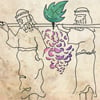
After the Exodus and the revelation at Sinai, the next step was the conquest of the Promised Land. At the people's request (and with G‑d's reluctant authorization), Moses sent twelve men — one from each tribe — to scout the land: its agricultural potential, its fortifications, its strengths and weaknesses. He also asked them to bring back samples of the fruit of the land, so the people could see the blessing awaiting them.
The scouts spent forty days in the land and returned. Ten of them gave this report: "The land is extraordinarily fertile" — and they displayed the enormous, lush fruit they had brought back. "But," they continued, "the people who inhabit the land are very powerful, the cities are large and heavily fortified, and we even saw giants there."
Seeing where things were headed, Caleb, one of the twelve, tried to turn the narrative around, concluding that they could conquer the land. His colleagues (except Joshua) disagreed, insisting that it was impossible. The people believed the negative report and broke out weeping. They complained to Moses, "Let us return to Egypt! We should never have left!"
It was a major crisis.
The ten scouts who brought the negative report died of a plague. The rest of the people would wander the desert for forty years, until the adult generation that had left Egypt died out; only their children — along with Joshua and Caleb — would enter the land.
But wasn't it entirely reasonable to be frightened by such a daunting challenge? Why were they punished for their fear? And as for the scouts who gave the negative report, hadn't Moses sent them precisely to evaluate the situation and report back? Why punish them for conveying what they saw?
Among many other explanations, the ten scouts made several errors: 1) They were sent to assess how best to conquer the land, not to render a verdict on whether conquest was possible. 2) Moses had not sent them because he himself needed information. He sent them so that they would see for themselves, and thereby enter the land convinced by their own experience and not merely on Moses's word.
Let’s apply these two lessons to the anxiety we face in our own lives.
One of the foundations of Judaism is Divine Providence: everything that happens is by Divine design. When you find yourself in a situation, it is not by chance but by intention. You did not choose to be there; G‑d placed you there. And if G‑d brought you to a specific place at a specific moment, it is because there is something you can and must do there—not only for your own growth and fulfillment, but also for the people, moment, and place in which you find yourself.
The question is not, "Can I do this?" That is G‑d's department. The question is: "How do I best fulfill this mission?" Knowing that the mission is G‑d's, and that success ultimately depends on Him, eliminates much of the anxiety that uncertainty creates. If G‑d trusts you with this, trust that you can meet His expectations!
Second, anxiety often arises when we take on too much responsibility. A great deal of responsibility empowers and motivates; too much crushes and paralyzes.
How do we tell the difference? "Too much" can be defined as anything we think, say, or do that is not actually productive. And the way to assess what falls within our genuine capacity and what exceeds it is difficult to do alone. Self-love distorts objectivity. Which brings us to our Sages' advice: Make yourself a teacher. Choose a trusted guide with whom to consult when making important decisions.1 Finding such a teacher is not easy, but navigating life without one is harder still.



Start a Discussion